
The Bio Pesticide Registration Process in India involves more than developing a biological product and taking it to market. If the product falls under India’s regulated insecticide framework, the appropriate registration requirements need to be addressed before commercial manufacture or import.
But one question often creates confusion:
What documents are actually required, and how does the bio-pesticide registration process work?

The answer depends on the product, active biological agent, formulation, intended use and applicable registration route.
In Part 1, we discussed what bio-pesticides are, their major types and the basic regulatory framework.
In this guide, we take a more practical look at the documents, technical information, registration steps and common issues businesses should understand before starting a bio-pesticide registration application in India.
Already familiar with the basics?
Read Part 1: Bio-Pesticide Registration in India – Types, Requirements & Complete Overview to understand the different categories and regulatory framework.
Quick Answer: How Does Bio-Pesticide Registration Work in India?
In simple terms, bio-pesticide registration in India involves identifying the correct regulatory route, preparing the required technical and safety documentation, and submitting a complete application through the applicable regulatory process.
The exact requirements depend on the product, active biological agent, formulation, intended use and applicable registration category.
What Documents Are Required for Bio-Pesticide Registration?
There is no single document list that applies identically to every bio-pesticide.
The exact requirements can vary according to the product and registration route. The official PPQS bio-pesticide checklist, for example, specifies different information and data requirements for applicable applications under Sections 9(3B) and 9(3).
However, businesses may need to prepare several categories of documents and technical information.
Quick Checklist: Bio-Pesticide Registration Documents
Depending on the product and applicable registration route, the documentation may include:
- Form-I and applicable fee
- Product composition
- Strain and accession information, where applicable
- Source or authorization documents
- Mother culture information, where applicable
- Safety, toxicity and infectivity data
- Formulation information
- Environmental and non-target organism data, where applicable
- Label and leaflet
- Human safety or worker-related information, where applicable
- Other supporting technical documents
Important: The exact document and data requirements should be checked against the applicable regulatory checklist for the specific product.
1. Application Form
A properly completed Form-I, along with the applicable fee, forms part of the registration application requirements for applicable bio-pesticide registrations.
The information in the application should accurately represent the product being submitted.
2. Product Composition
Details of the product composition are an important part of the application.
The composition should be clearly documented and should remain consistent with the technical information, formulation details and proposed product label.
3. Strain Information
For microbial bio-pesticides, information about the biological strain can be particularly important.
Depending on the applicable requirements, documentation may include:
- Strain identification
- Accession information
- Source of the strain
- Culture collection details
- Relevant supporting records
The PPQS checklist specifically refers to strain accession information for applicable bio-pesticide applications.
4. Source or Authorization Documents
Where the applicant is using a strain obtained from another organisation or source, appropriate authorization documentation may be required.
The PPQS checklist includes authorization from the inventor or source of the strain for applicable applications.
5. Mother Culture Information
For applicable microbial products, information relating to the mother culture may be required.
This information helps establish the identity and characteristics of the biological material used in the product.
6. Safety, Toxicity and Infectivity Data
Safety information is an important part of the regulatory assessment.
Depending on the biological agent and applicable registration route, studies may include areas such as:
- Oral toxicity/infectivity
- Pulmonary or intratracheal toxicity/infectivity
- Dermal toxicity/infectivity
- Intraperitoneal toxicity/infectivity
- Skin irritation
- Eye irritation
- Human safety information
The exact studies required should be determined from the applicable regulatory checklist rather than assumed from another product.
7. Formulation Data
The finished formulation may require separate supporting information from the source or mother culture.
Depending on the product, the regulatory documentation can include information relating to:
- Composition
- Formulation characteristics
- Safety
- Toxicity/infectivity
- Stability or other applicable technical parameters
The exact requirements depend on the product and applicable registration route.
8. Environmental and Non-Target Organism Data
For applicable registration categories, information about the effect of the product on non-target organisms may also be required.
The PPQS checklist for applicable 9(3) bio-pesticide applications includes data relating to areas such as:
- Bird toxicity
- Freshwater fish toxicity
- Earthworm toxicity
- Honey bee toxicity
- Silkworm toxicity
The requirements and applicable exceptions can vary according to the biological agent.
9. Label and Leaflet
The proposed label and leaflet are also important parts of the registration documentation.
They should be consistent with the information submitted in the application and should accurately communicate the approved product information and directions for use.
A label should not be treated simply as a marketing design.
For a regulated crop-protection product, it is part of the compliance documentation.
10. Human Safety and Worker Information
For applicable products and registration routes, health and safety information relating to workers may also be required.
The specific format and requirements should be checked against the applicable regulatory provisions and checklist.
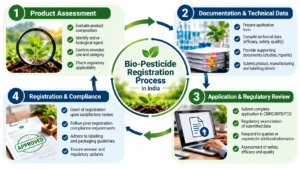
Bio-Pesticide Registration Process in India
Once the product requirements and documentation have been identified, the registration process can be approached in a structured way.
Step 1: Product Assessment
The first step is understanding the product itself.
This includes identifying:
- Active biological agent
- Microbial strain, where applicable
- Product formulation
- Target pest or disease
- Crop
- Proposed use
- Product claims
- Source of the biological material
This step helps determine what regulatory requirements may apply.
Step 2: Identify the Applicable Registration Route
Once the product has been assessed, the applicable registration route needs to be identified.
Businesses may encounter provisions such as Section 9(3) and Section 9(3B) during this process.
The requirements are not necessarily identical, which is why selecting the correct route before preparing the application is important.
PPQS publishes separate checklists covering applicable bio-pesticide registration requirements.
Step 3: Prepare the Technical Documentation
After identifying the applicable requirements, the supporting technical documentation can be compiled.
This may include:
- Composition details
- Strain information
- Source/authorization documents
- Safety studies
- Toxicity/infectivity studies
- Formulation information
- Environmental data, where applicable
- Labels and leaflets
- Other supporting technical information
This is often one of the most time-consuming stages because missing information may need to be obtained before the application can be properly completed.
Step 4: Prepare the Application
The relevant application form and supporting documents are then organised according to the applicable requirements.
At this stage, consistency is important.
For example, the product composition mentioned in the application should not conflict with the formulation information or label.
The same principle applies to the proposed crop, pest, disease and product claims.
Step 5: Submit the Application
Once the application and supporting documentation have been prepared, they can be submitted through the applicable regulatory process along with the prescribed fee.
The application should be complete and properly organised before submission.
Step 6: Regulatory Examination
The application is then subject to regulatory scrutiny.
The Registration Committee’s functions include scrutinising formulae and verifying claims regarding the efficacy and safety of insecticides.
The review is therefore not limited to checking whether a form has been submitted.
The technical information and claims associated with the product also matter.
Step 7: Respond to Queries or Additional Requirements
During the review process, the applicant may need to provide clarification or additional information.
For example, the authorities may require clarification regarding:
- Product composition
- Technical data
- Safety information
- Strain details
- Proposed claims
- Labelling
- Supporting documents
A clear and properly organised response can help keep the application moving through the relevant review process.
Step 8: Registration and Post-Registration Compliance
Once the applicable requirements have been satisfactorily addressed, the registration process can proceed to the applicable registration outcome.
But registration should not be considered the end of compliance.
Businesses must continue to follow the applicable requirements relating to manufacture, packaging, labelling, sale and use of regulated products.
Bio-Pesticide Registration Process at a Glance
The overall process can be understood through the following stages:
Product Assessment → Regulatory Route → Technical Data → Documentation → Application → Regulatory Examination → Query Response → Registration & Compliance
Each stage depends on the product and applicable regulatory requirements. A product-specific assessment should therefore be completed before finalising the application.
How Long Does Bio-Pesticide Registration Take?
There is no single fixed timeline for every bio-pesticide registration application in India.
The overall duration can depend on factors such as:
- Product category
- Registration route
- Availability of technical data
- Safety and toxicity studies
- Completeness of documentation
- Regulatory queries
- Additional data requirements
- Review procedures
If important technical data is missing before the application begins, the overall process can take longer.
For this reason, it is better to assess the product and documentation requirements first rather than relying on a fixed registration timeline.
What Can Delay a Bio-Pesticide Registration Application?
Several documentation and preparation issues can create avoidable problems.

Incomplete Technical Data
If required studies or supporting information are unavailable, the application may not be ready for submission.
Incorrect Registration Route
Using a generic checklist without first identifying the applicable route can lead to unnecessary documentation work.
Inconsistent Product Information
The application, technical reports, formulation details and label should describe the same product.
Missing Strain Information
For microbial products, incomplete strain identification or supporting information can become an important documentation issue.
Unclear Product Claims
The proposed claims should be carefully defined and supported by the appropriate information.
Poorly Prepared Label and Leaflet
The label should align with the approved product information and applicable regulatory requirements.
Can a Company Apply for Bio-Pesticide Registration Without Technical Data?
This depends on the product and applicable registration route.
Some bio-pesticide applications require specific technical, safety, toxicity or infectivity information.
For example, the PPQS bio-pesticide checklist specifies safety and infectivity studies for applicable products and registration categories.
Therefore, businesses should first identify the exact data requirements applicable to their product.
Is There a Separate Registration Process for Every Type of Bio-Pesticide?
Not necessarily.
The registration requirements depend on the product and applicable regulatory provisions rather than simply whether the product is bacterial, fungal, viral or botanical.
Different biological agents can have different technical and safety considerations.
This is why a product-specific assessment is useful before preparing the final application.
What Should I Check Before Starting Bio-Pesticide Registration in India?
Before starting an application, a business should first understand the product, active biological agent, formulation, intended use, proposed claims and source of the biological material.
The applicable registration route should then be identified, followed by a review of the technical, safety and supporting documentation required for that product.
This product-specific assessment can help prevent businesses from preparing documents based on an incorrect or generic checklist.
How OneTouch Agro Solutions Can Help
For agricultural businesses, one of the key challenges in bio-pesticide registration is understanding what needs to be prepared, which regulatory route applies and how the documentation should be organised.
OneTouch Agro Solutions provides bio-pesticide registration and regulatory support for businesses working with agricultural and crop-protection products..
Depending on the product and scope of work, support may include:
Product Assessment
Understanding the product, active biological agent, formulation, intended use and proposed claims.
Registration Requirement Guidance
Identifying the applicable registration requirements based on the product and regulatory route.
Documentation Support
Organising application forms, product information, technical documents and supporting records.
Technical Data Coordination
Helping identify the technical and safety information required for the applicable registration process.
Label & Leaflet Support
Assistance with regulatory documentation associated with product labels and leaflets.
Regulatory Query Support
Helping organise responses and supporting documents when clarification or additional information is requested.
Registration Process Assistance
Providing structured support through the relevant stages of the registration process.
The exact scope of support depends on the product and its applicable regulatory requirements.
A Practical Approach to Bio-Pesticide Registration
A good registration process starts well before the application is submitted.
A simple approach is:
1. Understand the product
2. Identify the active biological agent
3. Determine the applicable regulatory route
4. Prepare technical and safety data
5. Organise the application documents
6. Review the application for consistency
7. Submit through the applicable process
8. Respond to regulatory queries
9. Complete the registration process
10. Maintain post-registration compliance
This approach helps businesses avoid treating registration as a simple form-filling exercise.
Frequently Asked Questions
What documents are required for bio-pesticide registration in India?
Depending on the product and applicable route, documents may include Form-I, product composition, strain information, accession details, source authorization, safety and toxicity/infectivity data, formulation information, environmental data, labels and leaflets, along with other supporting documents.
What is Form-I in bio-pesticide registration?
Form-I is the prescribed application form used for applicable insecticide registration applications. The PPQS bio-pesticide checklist includes a duly completed and signed Form-I among the requirements for applicable applications.
Is toxicity data required for bio-pesticides?
The requirement depends on the product and registration route. Applicable bio-pesticide checklists include different safety, toxicity and infectivity requirements for different products and biological agents.
Is strain information required for microbial bio-pesticides?
For applicable microbial products, yes, strain-related information can form part of the registration documentation. The PPQS checklist refers to strain accession information for applicable applications.
What is the difference between 9(3) and 9(3B)?
They are different provisions within the insecticide registration framework, and the applicable documentation and data requirements can differ. Businesses should identify the correct route based on their specific product rather than assuming one checklist applies to both.
How long does bio-pesticide registration take?
There is no universal timeline. The duration can depend on the product, registration route, completeness of documentation, availability of technical data and any queries or additional requirements raised during the review.
Can OneTouch Agro Solutions help with bio-pesticide registration?
Yes. OneTouch Agro Solutions can assist with product assessment, registration requirement guidance, documentation planning, technical-data coordination, label/leaflet support and regulatory query assistance, depending on the product and scope of work.
Final Thoughts
Bio-pesticide registration in India involves more than completing an application form.
The right approach is to first understand the product, identify the applicable regulatory route and then prepare the technical, safety and supporting documentation accordingly.
For manufacturers and importers, getting this groundwork right can make the registration process more organised and help avoid unnecessary documentation issues.
If you are planning to manufacture or import a bio-pesticide in India, OneTouch Agro Solutions can help you understand the applicable requirements and provide structured registration and regulatory support.
Need Help With Bio-Pesticide Registration?
Talk to OneTouch Agro Solutions about your product and registration requirements.